Red Light Areas in Bangalore: Is There One?
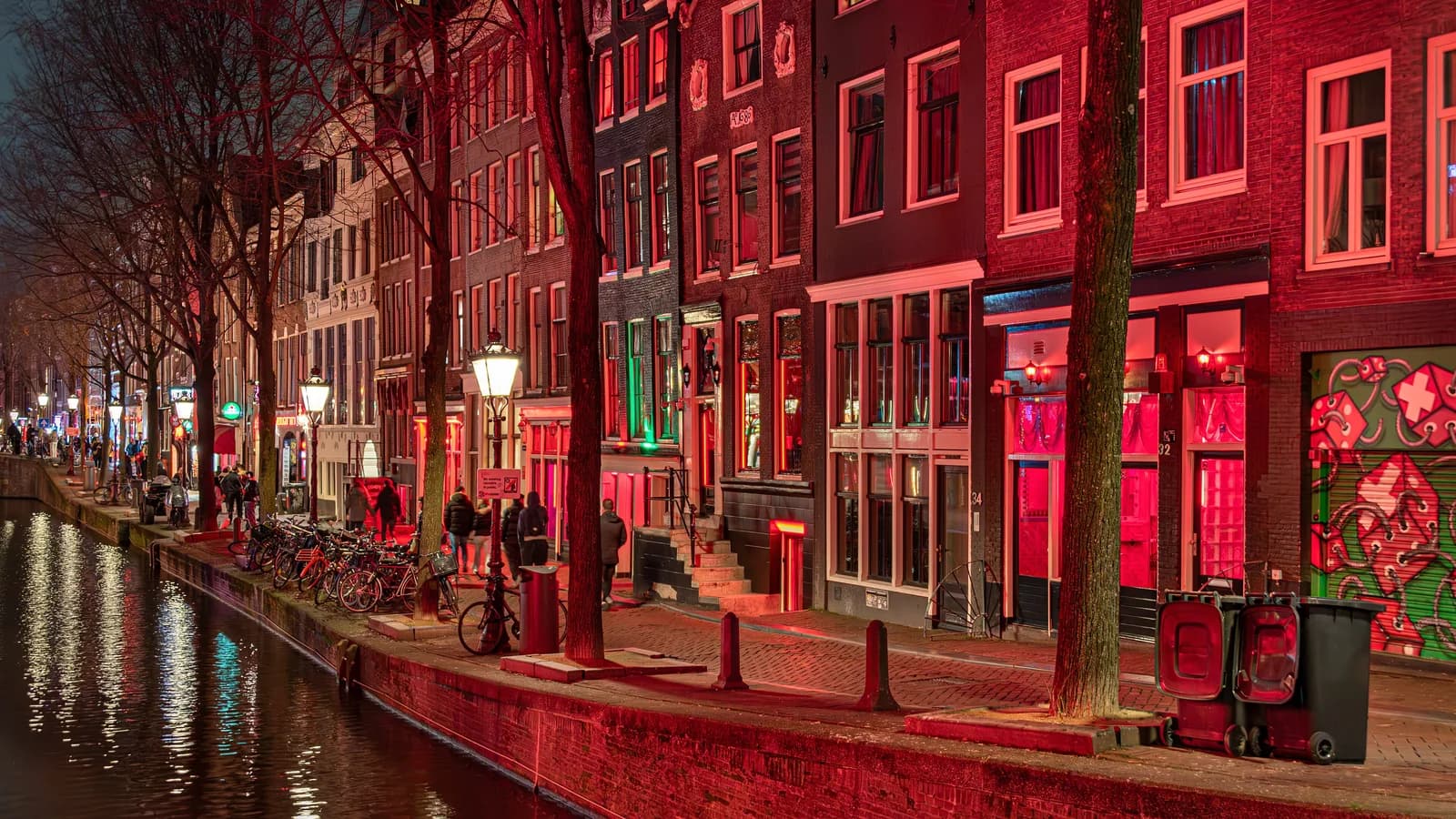
De Wallen in Amsterdam, the district the phrase red light area comes from. Photo: Jorge Franganillo, CC BY 4.0, via Wikimedia Commons.
Is there a red light area in Bangalore? Not a legal one. No city in India has a legal red light area, and that includes the famous districts in Mumbai, Delhi and Kolkata, which exist in practice but not in law. What Bangalore has is the grey area: real, scattered across the city rather than gathered in one place, tolerated unevenly, and raided now and then. This guide explains the difference, what the law actually says, what a search for a red light area near you tends to lead to, and what most people typing it are really looking for.
What a red light area actually is
The phrase comes from the red lamps that once marked brothels in European and American port cities, and it has come to mean any district where paid sex is sold openly from the street or from known buildings. In India the term carries an extra assumption that it does not carry anywhere else: that somewhere, a government has drawn a line on a map and said this part is allowed. No such line exists, in Bangalore or anywhere in the country, and the rest of this guide starts from that fact.
Why no city in India has a legal red light area
The law that governs this is the Immoral Traffic (Prevention) Act, 1956. The only power it gives anyone over an area is in section 7: a state government can notify an area in which prostitution is prohibited. That is the whole of it. There is no section anywhere in Indian law that lets a government, a police commissioner or a municipality designate, license or permit a red light area. The power runs one way only, towards prohibition.
So every page that describes a legal, licensed or government-approved red light area in Bangalore, or anywhere else in India, is wrong as a matter of law before it says anything else.
India's famous red light areas, and why Bangalore is different
| Place | City | What it is | Legal? | Shape |
|---|---|---|---|---|
| Kamathipura | Mumbai | The city's old red light district, dating to the colonial era | No | One district, raided periodically |
| GB Road | Delhi | A single street in the old city known for its multi-storey brothels | No | One street |
| Sonagachi | Kolkata | The city's red light district, home to a large sex workers' collective | No | One district |
| Bangalore | Karnataka | No fixed district at all; scattered pockets and phone-arranged flats | No | Dispersed, a grey area |
Kamathipura, GB Road and Sonagachi are the best-known red light areas in the country, and not one of them is legal. They exist because of history, density and decades of tolerance, not permission, and each of them is raided. They are also the reason the search exists: people assume every big city has its Kamathipura, and go looking for Bangalore's.
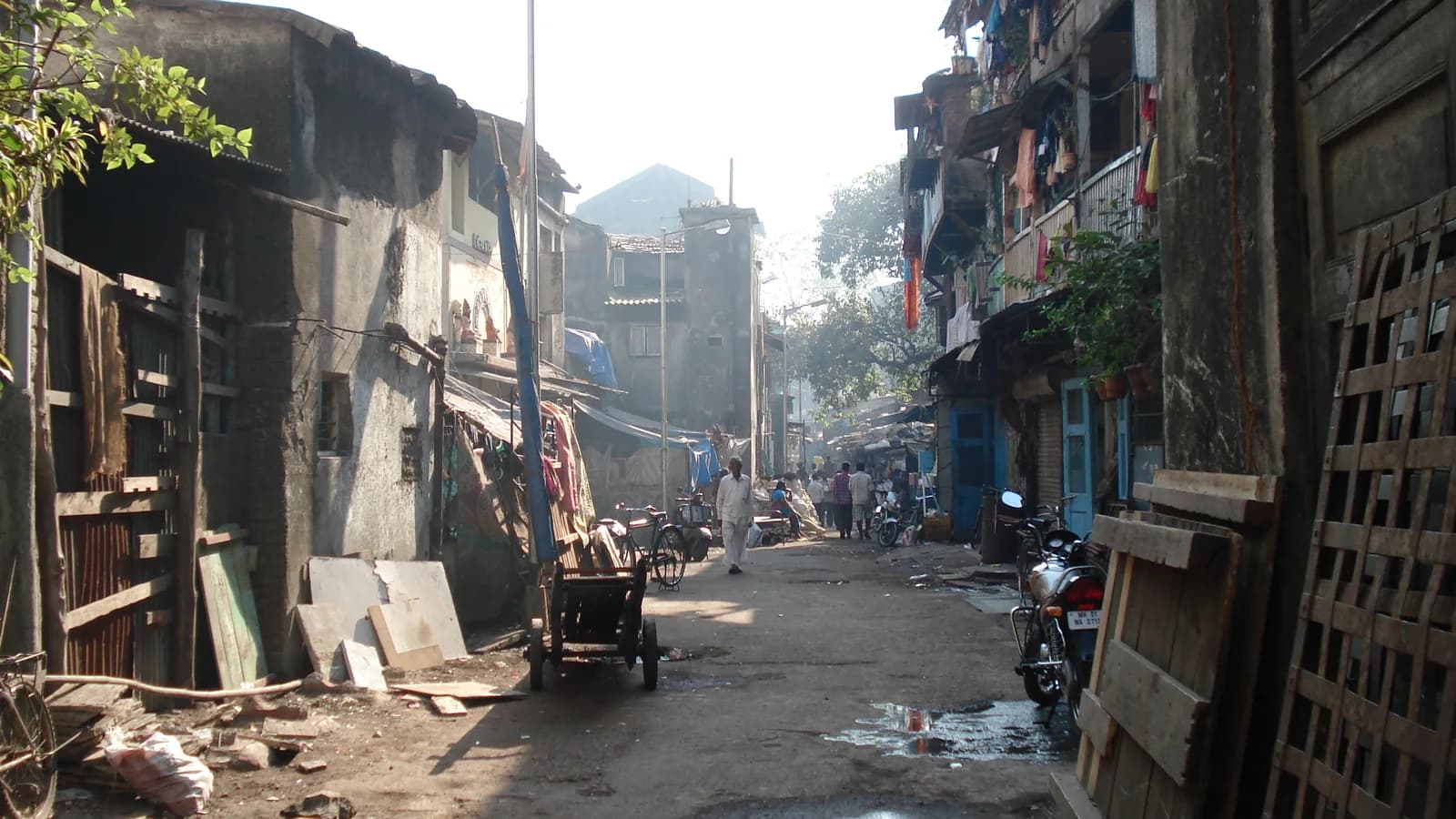
What Bangalore actually has: the grey area
None of that means nothing happens here. It does, and anyone who has lived in the city for a few years has seen some version of it. What Bangalore does not have is a Kamathipura: a single old district everyone can name. Two things on the public record explain why.
The first is the Supreme Court. In Prajwala v. Union of India, decided on 29 May 2026, the court described how brothel-based exploitation has moved out of fixed districts and into scattered, phone-coordinated premises, which is a large part of why the old model of rescue raids on known buildings no longer fits. The second is the Bengaluru police. On 2 June 2026 the Central Crime Branch broke a racket run through rented houses spread across the city and coordinated entirely by phone, arresting four people and rescuing three women. That is the shape of the trade here: pockets and phone numbers, not a street with a name.
The pockets are real, and they look much the same in every Indian city of this size.
Highway lodges and dhabas
Short-stay lodges and roadside dhabas along the stretches that run out of town. Rooms by the hour, a broker at the counter, and the police drive that comes through a few times a year.
Rooms let by the hour
Paying-guest buildings where a room is let for an hour rather than a month, usually through a broker rather than the owner. The building looks like every other PG on the street.
Brokered "service apartments"
A man with a phone, a flat he does not live in, and a listing that calls it a service apartment. Most of the advance-payment scams in the city start with this kind of number.
Old lanes near a market
A few old lanes near a wholesale market where this has gone on for decades and gets a little quieter each year. The last visible trace of the old district model.
A number and a flat
The quiet version that is most of it now: a number that answers, a flat somewhere in the city, and a visit arranged on the phone. Nothing to see from the street at all.
Tolerated unevenly means exactly that. The police act when there is a complaint, a trafficking lead or a department drive. The same lane can be left alone for months and raided twice in a week. Nobody standing in it has any way of knowing which week it is.
Why this guide does not list the red light areas in Bangalore
Search red light area Bangalore and the lists you will find all do. They name six or twelve or fifteen neighbourhoods, give each a number, and often add a price. We looked at the ones that rank, and three things are true of all of them. None of them cites a source. They contradict each other: one says a lane is mostly gone now, the next lists it as active with rates; one lists the same area twice under two different numbers; one is still dated two years ago. And several of them name ordinary residential neighbourhoods where tens of thousands of people live, on the strength of rumour.
What the law actually says
This is a plain summary of the law as it stands, written for readers rather than lawyers. It is not legal advice.
| Section | What it makes an offence | Who it catches |
|---|---|---|
| ITPA s.3 | Keeping a brothel, or letting premises be used as one | The lodge owner, the PG landlord, the broker |
| ITPA s.4 | Living on the earnings of someone else's prostitution | The pimp, the broker, the "manager" |
| ITPA s.5 | Procuring or inducing a person for prostitution | Anyone who recruits or brings a woman in |
| ITPA s.7 | Prostitution in or near a public place, or in a notified area | Both parties, in the places the street version happens |
| ITPA s.8 | Soliciting in a public place | Whoever is soliciting, and the man standing with her when the police arrive |
| BNS s.143 | Trafficking. Consent is no defence | The operator, and anyone who knowingly benefits |
Read those two rulings carefully, because they are easy to misread. Neither of them legalised brothels, soliciting, pimping or living off someone else's earnings. Every one of those is still an offence. What the court protected is the worker, from the police. It did not create a right for customers, operators or anyone in between. That is why grey area is the precise phrase: the act itself is not a crime, and almost everything built around it is.
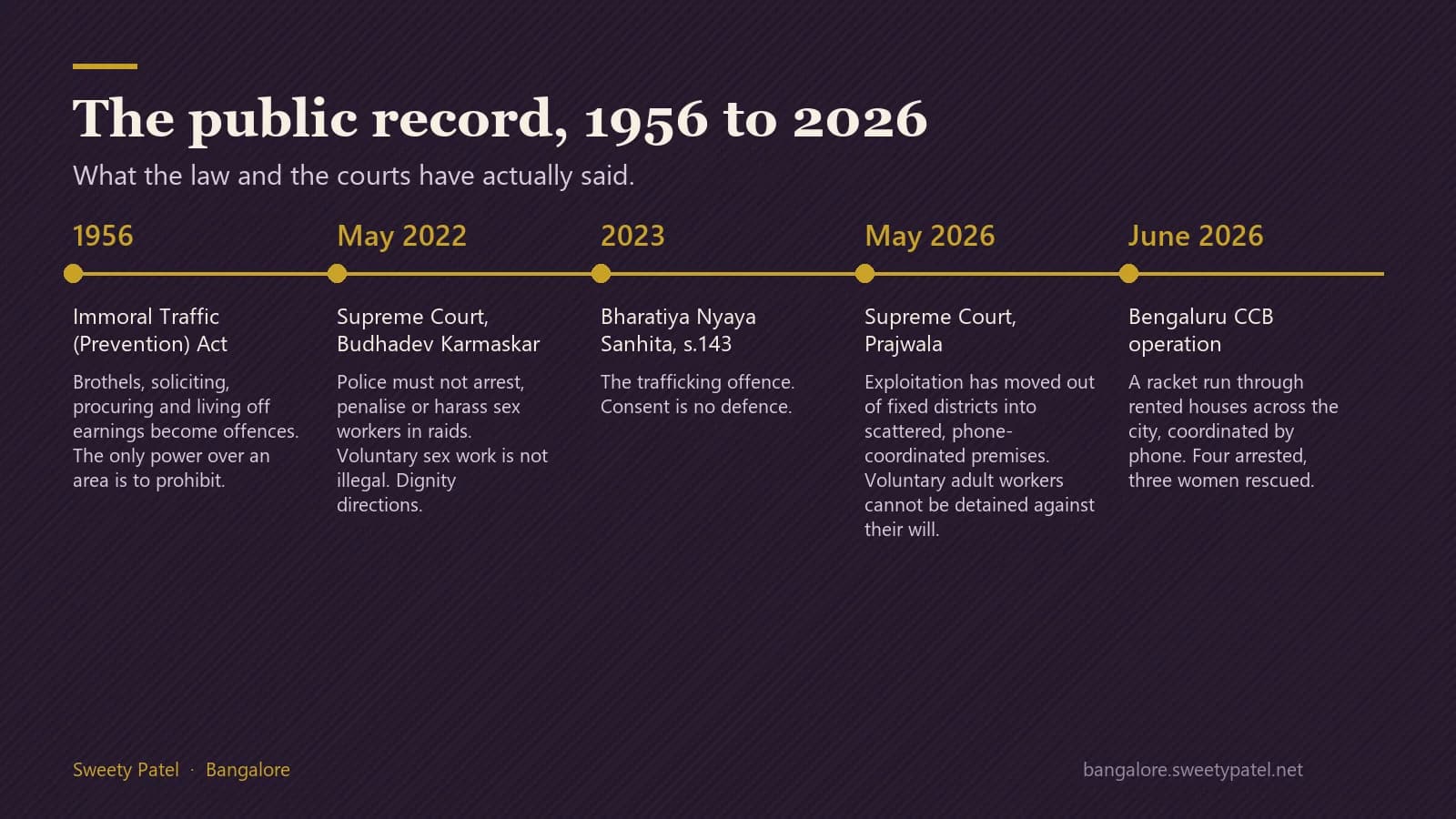
The same record, in words:
| When | What | What it established |
|---|---|---|
| 1956 | The Immoral Traffic (Prevention) Act | Brothel-keeping, soliciting, procuring and living off another's earnings become offences. The only power the Act gives over an area is to prohibit prostitution in it; none to permit it. |
| 19 May 2022 | Supreme Court, Budhadev Karmaskar v. State of West Bengal | Sex workers are not to be arrested, penalised or harassed during brothel raids; voluntary sex work is not itself illegal; police must treat them with dignity. |
| 2023 | Bharatiya Nyaya Sanhita, section 143 | The trafficking offence. Consent of the person trafficked is no defence. |
| 29 May 2026 | Supreme Court, Prajwala v. Union of India | Brothel-based exploitation has moved out of fixed districts into scattered, phone-coordinated premises. A voluntary adult sex worker cannot be rescued or detained against her will; a magistrate must examine each person's situation. |
| 2 June 2026 | Bengaluru Central Crime Branch | A racket run through rented houses across the city and coordinated entirely by phone is broken: four arrested, three women rescued. The shape of the trade here is pockets and phone numbers, not a district. |
What a search for a red light area near you actually leads to
People who search this usually end up in one of two places, and both are worse than they look.
The contact-number page
- A page promising a red light area contact number or an address. It exists because the search exists.
- The number asks for a booking amount, a token or a security deposit on UPI before anyone will come.
- The money goes. The number goes quiet.
- This is the single most common way men are cheated in this city, and it is built on exactly this search.
The street
- Soliciting in a public place is itself the section 8 offence. A man standing in that lane is standing next to an offence when the police arrive, and they do arrive.
- Inflated room charges, theft, and drinks you did not watch being poured.
- Nobody on that street has checked anyone's age, health, or whether she is there by choice.
- The trafficking cases in the court record come from precisely these places.
The rates quoted on the listicles, a few hundred rupees to two thousand, are not a bargain. Where they are real at all, they are the price of someone being exploited, and that is the version of this trade the trafficking law exists for.
What most people searching this are really looking for
Strip away the curiosity and the vlogs and what is usually left is simple: an evening of paid adult company, arranged privately, with someone who is there by choice. That is a legitimate thing to want, and in Bangalore it is also how the grey-area side of this actually works for most people, most of the time. Not on a street. By phone, in a private flat or a hotel room, by arrangement, with a person whose photos you have seen and whose rate you know before you leave the house.
That is what an agency does, and it is what we do. Every profile on this site is one we created and manage ourselves. Adult age and identity are checked before anything is published, the photographs are confirmed to be of the person listed, and the rate is fixed before you message. Nothing is paid in advance, ever, which is the one rule that would have saved most of the men who end up on the contact-number pages. That includes the trans and shemale escorts in Bangalore we list, who are checked and booked the same way. Every one of our Bangalore escorts is a profile we created and manage ourselves, not a listing someone else placed, and all our call girls in Bangalore are on one page with their own photos, areas and rates.
How a booking actually works here
Four steps, and none of them involves a street.
- Pick a profile and note her name.
- Send one message on WhatsApp: her name, your area or hotel, the day and time, and how long you want.
- We confirm she is free and settle whether she comes to you or you come to a place we arrange.
- She arrives at the time agreed, and you pay her in cash then.
An hour is Rs 5,000 and a full night is Rs 20,000, and the ladder is the same for every profile. If it is your first time, the guide to your first escort booking in Bangalore walks through it, and the one on incall and outcall in Bangalore explains where you meet. We cover 52 areas of Bangalore, and the safety and scam guide is worth ten minutes before you message anyone, us included.
If you or someone you know is being forced
Sources
Everything above is drawn from the primary texts and the court record, not from other websites.
- The Immoral Traffic (Prevention) Act, 1956_act,_1956.pdf), India Code, Ministry of Law and Justice; also on Indian Kanoon. Sections 3, 4, 5, 7 and 8.
- The Bharatiya Nyaya Sanhita, 2023, India Code; also on Indian Kanoon. Section 143.
- Budhadev Karmaskar v. State of West Bengal, Supreme Court of India, order of 19 May 2022, and the LiveLaw report of the directions.
- Prajwala v. Union of India, 2026 INSC 609, Supreme Court of India, 29 May 2026, and the LiveLaw report of 31 May 2026.
- CCB busts prostitution racket in Bengaluru, arrests four, NewsKarnataka, 2 June 2026.
Image credits: De Wallen, Amsterdam, by Jorge Franganillo, CC BY 4.0, via Wikimedia Commons; Bangalore skyline by Saad Faruque, CC BY-SA 2.0, via Wikimedia Commons; Kamathipura lane by Hawk4256, public domain, via Wikimedia Commons. The timeline graphic is ours.
Questions people ask
- Is there a red light area in Bangalore?
- Not a legal one, and no legal red light areas in Bangalore or anywhere in India, because the law has no way to create one; the only power in the Act is to prohibit an area, never to permit one. What exists is a grey area: real, scattered across the city in lodges, hourly rooms and phone-arranged flats, tolerated unevenly and raided periodically. There is no single Bangalore red light area in the way Kamathipura or GB Road is one for its city.
- What is a red light area?
- A district where paid sex is sold openly from the street or from known buildings. The name comes from the red lamps that once marked brothels in port cities. In India the phrase is often assumed to mean a legally permitted zone, and no such zone exists anywhere in the country.
- Which are the red light areas in Bangalore, and is there a list?
- We do not name neighbourhoods, and the lists that do are unsourced, copied from each other and contradict one another. Naming a residential area on rumour is unfair to the people who live there and is wrong about half the time. The pockets are types of place, not addresses: highway lodges, hourly rooms, brokered flats, a few old lanes near a market.
- Is prostitution legal in India?
- It is a grey area, and that phrase is exact. An adult privately selling sex is not itself an offence, and the Supreme Court has directed that sex workers are not to be harassed or detained against their will. Keeping a brothel, soliciting in public, procuring and living off someone else's earnings are all offences, and trafficking is a serious crime to which consent is no defence.
- Which is the biggest red light area in India?
- Sonagachi in Kolkata and Kamathipura in Mumbai are the two usually named, with GB Road in Delhi the best-known in the north. None of the three is legal; each exists through history and tolerance and each is raided. Bangalore has nothing comparable.
- Is it safe to go looking for a red light area in Bangalore?
- No. Public soliciting is itself an offence, so you are standing next to one when the police come; the contact-number pages are advance-payment scams; and nobody on that street has checked anyone's age or consent. The trafficking cases in the court record come from exactly these places.
- What does a red light area in Bangalore contact number actually get you?
- Almost always a request for a booking amount or token on UPI, and then silence. Nobody genuine asks for money before a meeting. If a number does, it is not real, whoever it claims to be.
- What is the legal way to meet an escort in Bangalore?
- By arrangement, in private, with an agency that checks who it publishes. Pick a profile, message on WhatsApp, meet at a private place, pay in cash when she is in front of you. Nothing in advance, nothing on a street.
About the writer
Sweety Patel founded this agency in 2026 and writes these guides. Every profile on the site is created and checked here before it goes up: adult age and identity confirmed, and the photographs confirmed to be of the woman listed. There are no outside listings and no middlemen, so when you message, you are talking to the people who run it. More about the agency.